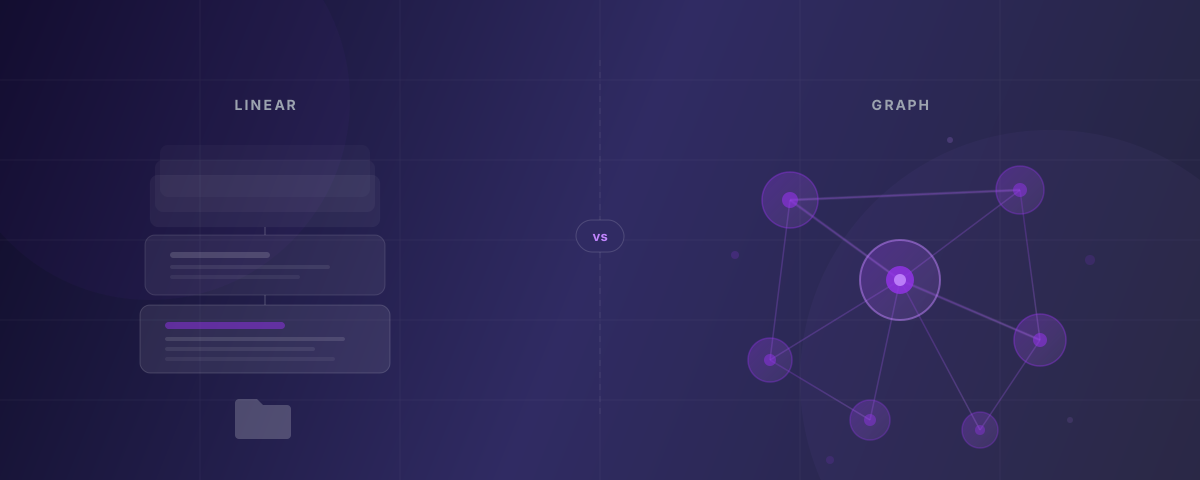
When organizing ideas, most people use one of two systems:
- Linear note-taking (structured documents and folders)
- Graph note-taking (connected, networked ideas)
Both approaches work. But they shape your thinking in very different ways.
And over time, that difference matters.
What Is Linear Note-Taking?
Linear note-taking is the traditional format most of us are used to.
- Notes live inside documents
- Documents live inside folders
- Content flows top to bottom
- Structure is hierarchical
It mirrors how books and reports are written — sequential and organized.
Strengths of Linear Notes
✅ Clear structure
✅ Easy to read and share
✅ Great for final drafts
✅ Works well for straightforward tasks
Linear systems are excellent for producing clean, polished output.
The Hidden Limitation of Linear Thinking
Here’s what often goes unnoticed:
Linear note-taking subtly pressures you to structure while you think.
When writing in a traditional document, you naturally start worrying about:
- Is this in the right section?
- Should this be a heading?
- Does this belong in another file?
- Is the formatting clean?
You begin organizing before fully exploring. That can hinder fluent, borderless thinking. Instead of letting ideas flow freely, you manage layout, structure, and placement at the same time. For complex topics, this slows down creativity and discovery. Linear systems assume you already know the structure. But during early thinking, you usually don’t.
What Is Graph Note-Taking?
Graph note-taking removes the pressure to organize upfront. Instead of stacking notes inside folders, you connect ideas to other ideas.
Each note becomes a node.
Connections create relationships.
Structure emerges over time.
You don’t need to decide where something “belongs.” You only need to decide what it relates to. That small shift unlocks a more natural thinking process.
Where Graphora Comes Into Play
This is where Graphora bridges exploration and structure.
In Graphora, you can start completely unstructured:
- Capture quick thoughts in daily journals
- Write atomic notes without worrying about hierarchy
- Create backlinks between ideas
- Let patterns emerge naturally
There’s no pressure to design the perfect outline while thinking. You can explore freely.
Then, when clarity appears, you can transform those connected ideas into structured pages. Backlinked notes evolve into organized documents. Scattered insights become clean outlines. Daily thoughts turn into finished work.
You move from:
Unstructured exploration → to structured clarity. Instead of choosing structure first, you allow it to form from your thinking. That’s the key difference.
The Core Difference
Linear note-taking is:
Structure → then thinking.
Graph note-taking is:
Thinking → then structure.
Linear systems are optimized for presentation. Graph systems are optimized for idea development.
If your work is simple and short-term, linear tools are enough. But if your ideas grow over months or years, forcing structure too early can limit how deeply they connect.
Which Is Better?
It depends on your stage of work.
Choose Linear If:
- You’re writing a final report
- You need sequential clarity
- The topic is simple and well-defined
Choose Graph If:
- You’re researching
- Brainstorming
- Connecting multiple fields
- Building long-term knowledge
For exploration, graph systems allow freedom. For refinement, structured pages bring clarity. The most powerful workflow combines both — starting without borders, and finishing with structure.
Final Thought
The real question isn’t: “Which system is better?”
It’s: “When should structure enter the process?”
If structure comes too early, it can limit creativity. If structure never comes, ideas stay chaotic. The ideal system lets you think freely first — and organize when ready. That’s where connected note-taking becomes more than storage.
It becomes a thinking tool.